Basket Empty
Compendium
Augustin Souchy Bauer
- Known for
- Journalist
- Born
- Died
Biography
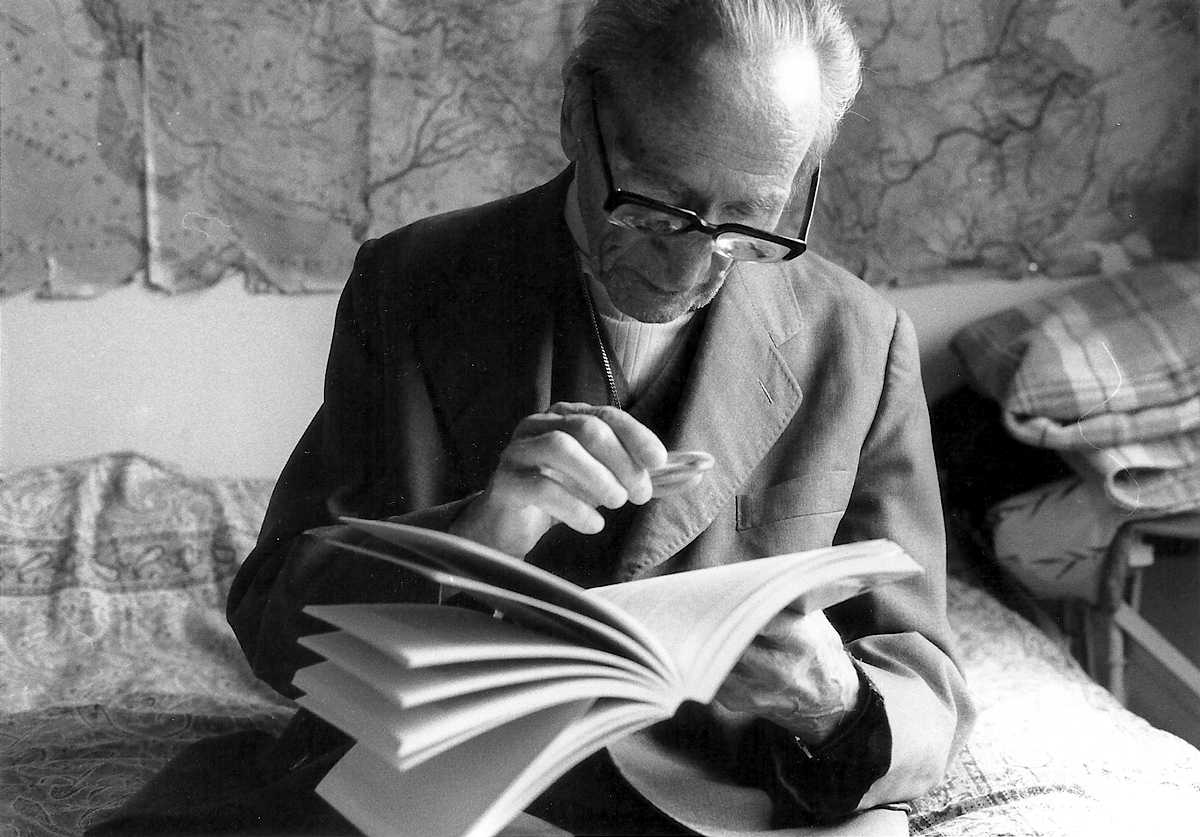
German journalist, anarchist, anarcho-syndicalist and anti-militarist. He became an anarchist at a very young age after reading Gustav Landauer and, in 1911, he went to Berlin, where the 19 year old Souchy met Karl Liebknecht, Clara Zetkin, Gustav Landauer, and other revolutionaries. At the outbreak of war in 1914, Souchy was in Vienna where he was arrested and deported to Germany. At the top of his arrest warrant were the words: "Beware! Anarchist!", which would become the title of his 1977 autobiography. From Germany he went to Sweden to escape conscription. There he was arrested for problems with his passport but managed to escape and cross over into Denmark and Norway clandestinely. Back in Sweden, in 1917, he took the opportunity of the fact that sick and wounded German soldiers on their way home from the Russian front having to change trains in Stockholm, handing out an anti-war pamphlet, 'Warum?', which he had written to the soldiers. Arrested and expelled from the country, only to return with the aid of a false passport. However, he is arrested whilst travelling to Copenhagen in 1919 and imprisoned for 6 months, time he uses to learn Swedish and to write the first book in that language about the recently assassinated Gustav Landauer.
Returning to Germany in late 1919, he joined the Freien Arbeiter Union Deutschland (FAUD), becoming the editor of its journal, 'Der Syndicalist' (from 1922-33). In 1920, he traveled to Russia for the Congress of the Third International, meeting Victor Serge, Zinoviev and Lenin. "I had expected from the social revolution more than a mere replacement of the tsarist autocracy by an authoritarian party dictatorship." During his stay, he spent 6 months visiting Kropotkin, who was then still at liberty, who warned him against the use of an authoritarian political party as an instrument with which to gain power. Six months later, in March 1921 came the suppression of the Kronstadt uprising, and followed by a wave of terror which compelled many SRs, syndicalists and anarchists to leave the "mother country of the world revolution." On his return, he wrote a highly critical book, 'Reise nach Russland 1920' (Travel to Russia 1920), about the Soviet regime. In 1922, he helped form the International Workers' Association (IWA/AIT) and, along with Rudolph Rocker and Alexander Schapiro, was one of three secretaries of the new organisation, which was set up to counter the Bolshevik Profintern (Red International of Labour Unions). Between 1924 and 1926, he was responsible for writing much of 'Die Internationale', the FAUD theoreical journal, and went on to write a number of important books including 'Sacco und Vanzetti' and 'Schreckensherrschaft in Amerika' (Reign of terror in America), both 1927. As a representative of the IWA, he went to Argentina in 1929 to take part in a Congress of Latin American anarcho-syndicalists in Buenos Aires. During his stay, he also undertook a lecture tour in Uruguay. In this period he also met Durruti for the first time and began to pay regualr visits to Spain on IWA business. On his return from South America, he became involved in the burgeoning anti-fascist movement but, following the Reichstag fire, which was immediately followed by the arrest of Erich Mühsam, life for Souchy and other radicals became increasingly dangerous. Shortly after the fire, he was attacked by three young men in front of his house in Wilmersdorf. He managed to break free and, heeding the warning, escaped to France. "When I was on the train taking me to Paris, people were glued to the Berlin newspaper columns with pictures of wanted anti-Nazis, including my own ... on Germany a bloody curtain had fallen. My second emigration would last longer than the first."
He settled in Paris, earning a living as a freelance journalist, working mainly for the foreign press and especially for Swedish newspapers, for one of whom he wrote the anti-Nazi polemic 'Die braune Pest' (The Brown Palgue). Just before the outbreak of the Spanish Civil War, he was invited by the CNT to speak at a mass meeting in Barcelona against the impending war. Instead of the rally, he arrived in time for the military coup and ended up staying in Spain for 3 years. Handed a weapon, he waved it around, claiming not to know what to do with it: "Only for the present, the word is also a weapon, soon there will be other tasks to perform." On the evening of the third day of fighting, Augustin took to the airwaves on Radio Barcelona to announce the victory of the revolutionaries. He was soo appointed head of external relations (Information in Foreign Languages) and political advisor of the Confederación Nacional del Trabajo and tried to organise getting money and arms from France for the CNT-FAI including an unsuccessful trip on behalf of the CNT to Paris at the end of August 1936 to negotiate with Léon Blum, the former Socialist Prime Minister. Later, he wrote his most influential books on collectivisation in Anarchist Catalonia - 'Die Bauern von Aragon' (The Peasants of Aragon; 1937) and 'Nacht über Spanien: Anarcho-Syndikalisten in Revolution und Bürgerkrieg 1936–39. Ein Tatsachenbericht; 1955' (Night over Spain: Anarcho syndicalism in revolution and civil war 1936-39. A factual report; 1955). He also wrote 'The Tragic Week in May', one the few firsthand accounts of the Barcelona May Days of 1937 available. After the defeat of the Spanish Revolution in 1939, Souchy attempted to return to France. On the trip north, his refugee column was strafed by enemy aircraft and he broke his arm saving a small girl from falling under the wheels of a car. A doctor requisioned him a car and he managed to make it to Paris without being interned.
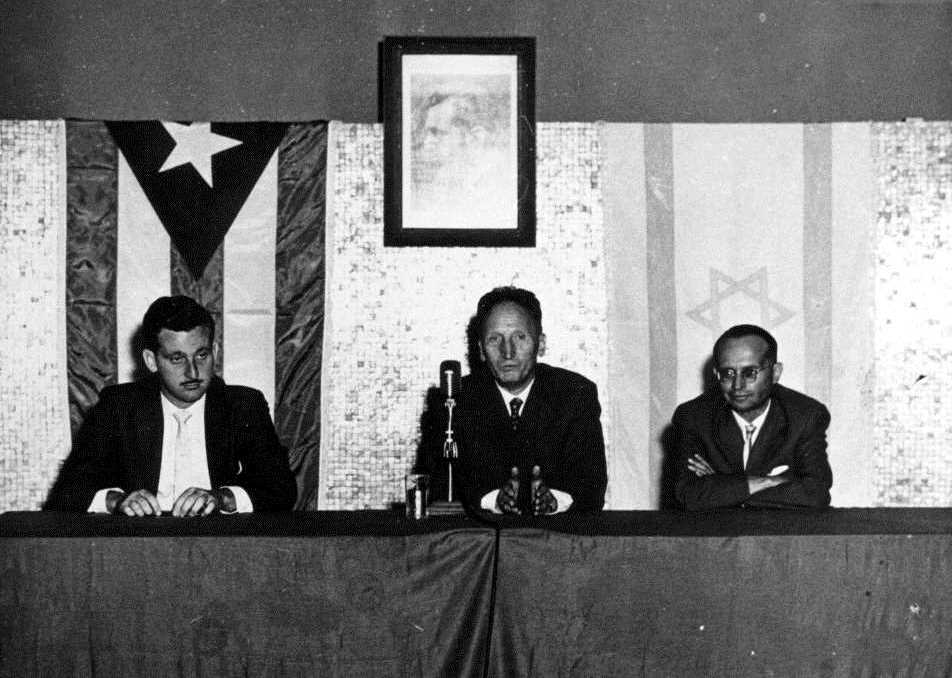
War was yet to break out and he spent times working as a correspondent for various Swedish and American newspapers again. At the start of WWII, German citizens were interned, being sent to a prison camp in the interior but, having a French wife, was released. This provision was eventually repealed and he ended up in a warehouse on the Brittany coast. The Wehrmacht took Paris and proceeded to the Channel coast. When they were in sight of the camp, Augustin managed to persuade the camp commander to give him and other political or Jewish camp inmates the opportunity to escape. He had spent nearly two years in various prison camps and now made his way by bicycle to Marseilles, hoping to escape the country. From there he manage to make it to Mexico. "Mexico meant the end of insecurity, persecution and threats., I took the opportunity offered." Mexico in 1942 was now one of the main centres for Spanish Civil War exiles, and there Augustine found a trade union organisation that was very close to the anarcho-syndicalist ideals. During the presidency of Lázaro Cárdenas (1934-40), hundreds of farms, factories, mines and service companies had been taken over by the workers and were still run as cooperatives. For some of these he advised on agricultural iniatives. He also traveled as a lecturer throughout the country and help the unions in educational work. In Loma Bonita, in the house of an old friend, who had also fought in Spain, he found for more than ten years of a new home. Invited by the Movimento Libertario Cubano, he travelled in February 1948 to Havana, where he attended its Congress and used the opportunity to study and went on a lecture tour of the inland, returning after four months to Mexico.
This was the beginning of an extensive period of travels, his "student revolution", as he often called the next 20 years: to Germany, Sweden, ,the United States, ,all countries of Latin America, from Mexico to Chile, as representative of the International Confederation of Free Trade Unions to Madagascar, to Yugoslavia, Israel (studying the kibbutzim), Italy, studying and lecturing. "The direct study of economic innovations in revolutionary countries and their practical functioning, so to speak, I had made my specialty." In May 1951, the exile organisation of the Spanish anarcho-syndicalists in Toulouse organised an international congress of the IWA. Augustine attended as delegate of the Föderation Freiheitlicher Sozialisten Deutschlands (German Federation of Libertarian Socialists Deutschalnds), a successor FAUD and in which Rudolf Rocker and Helmut Rüdiger were also involved. In 1963, he was commissioned by the International Labour Office in Geneva as an educational expert to travel round Jamaica, Honduras, Venezuela, Chile, Uruquay and Ethiopia for 3 years as an educational expert. In 1966, at the ripe old age of 74, he returned to Germany. - "When I had crossed the threshold of the biblical age, I had to remember to make me settle down." He went on to write extensively (both journalism and numerous books), appeared regularly on the radio, attended conferences and workshops and appeared in the documentary 'Kleinen Fernsehspiel', broadcast a month after his death from Pneumonia aged 91 on January 1, 1984. There was no funeral and no grave - Augustin had bequeathed his body to science.
Archive
Gallery