Basket Empty

Compendium
Luigi Galleani
- Known for
- Insurrectionist
- Born
- Died
Biography
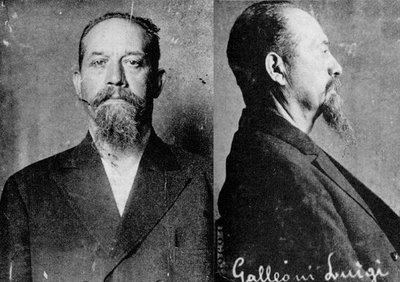
Anarchist born in Vercelli Italy. Famous internationally, he was a proponent of propaganda by the deed. Galleani became versed in legal and political theory at the University of Turin while acquiring a law degree. As a fervent supporter of Anarchism, he was wanted by the Italian police. Consequently, Galleani fled Turin before completing his degree in 1880. Galleani wound up in France, where he would spend 20 years. He spent a brief period in Switzerland before being deported. Galleani was deported soon after arriving in France, and returned to Italy.
In Italy he was arrested and detained for several years in prison and on the island of Pantelleria. He married a woman on the island and fathered four children by her. He escaped the island to Egypt, where he was soon in danger of extradition. Fearing a return to Italy, Galleani fled to England, where he immigrated to the United States, settling initially in New Jersey where he was editor of La Questione Sociale. In 1902, Galleani was wounded at a demonstration during the Patterson silk strike, and later indicted for inciting to riot. He fled to Canada, where he was literally thrown across the border. Arriving in Barre Vermont, Galleani found refuge with the Italian stone masons in the area. He was the founder and editor of the Cronaca Sovversiva, a major Italian anarchist periodical which ran for a period of about 15 years before being shut down by the U.S. government.
A supporter of “propaganda by deed” Galleani’s weekly newspaper Cronaca Sovversiva, published while he was in exile in America (which ran for a period of about 15 years before being shut down by the U.S. government), gained international attention during the trial of Sacco and Vanzetti. The supposed association of the two accused anarchists with the paper was used as evidence of their avowal of violence. Several books that bear his name are excerpts from Cronaca Sovversiva. The one exception is La Fine dell'anarchismo? (The End of Anarchism?) in which Galleani asserts that Anarchy is far from dead, but in fact is a force to be reckoned with.
As a defender of “propaganda by deed,” the perspective used to explain acts of violence and attacks on property, Galleani refused to separate individual acts of rebellion from the context in which they arose. Likewise he declined to separate individual acts of rebellion from the broader revolutionary process, seeing it as a necessary phase between theoretical affirmation and insurrectionary movement. For Galleani, there is no point in condemning such an act because it originates in an intricate convergence of predisposing conditions which, at certain times, demand it. Galleani presents “propaganda by deed” as the manual counterpart to the intellectual labour of speeches, writings, denunciations and public meetings. One fulminates, the other acts; both are necessary.
Galleani draws a distinction between “anarchist-communism” and “socialist-collectivism” and offers a critique of the “administrative government” or council which some socialists envision as a replacement for the state. He also provides a strong defence of the “free individual within the free society” arguing against even limited administration and representation. Galleani also establishes himself as a firm opponent of reformism, using economic as well as political arguments to illustrate how reforms restore the advantage of capital, helping capitalists to revise and extend their rule. Reforms (“the ballast the bourgeoisie throws overboard to lighten s old boat in the hope of saving the sad cargo of its privileges from sinking in the revolutionary storm,” are the business of ruling classes, not anarchists or socialists.
In place of short-ranged reformism Galleani advocates “tactics of corrosion” and “continuous attack.” Galleani offers an immanent view of anarchism, seeing anarchist proclivities in selfless acts of aid and support in the present. Galleani also reminds his readers that such acts are received with a joy and appreciation “never greeted a commandment of god, an edict of a king, a law of parliament (27). Recognizing the daily contradictions and obstacles (jobs, rent) anarchists face, he advocates, wherever possible, carving out realms of autonomy, creativity and self-determination.
Such tactics should not be limited to pursuing material gains, even though Galleani and his comrades were extremely poor, but must seek a more extensive experience and deeper awareness in various aspects of life. Galleani enthusiastically advocates “immediate attempts at partial expropriation” along with “individual rebellion” and insurrection “for the sake of struggle itself” . Galleani is also a proponent of “the inevitable use of force and violence” in order to obtain the “unconditinoal surrender of the ruling classes”, recognizing that, in the end they will only yield to force.
In rather harsh terms, Galleani dismisses the supposed disagreement between “individualist” anarchists and “organizational” anarchists as having no “really important basis,” characterizing it rather as “only the result of incomprehension and equivocation, caused more often by inaction and indolence than by bad faith, and which hard experience is bound to dispel”. Galleani’s position derives from his definition of anarchism as the struggle for a social condition in which the solidarity of material and moral interests provides the only link among individuals, in the absence of vicious competition. The character of solidarity is itself formed from spontaneity and freedom. Communism, understood as a free co-operation of people, and individualism, development of the individual free from institutional authority, rather than being contradictory or incompatible, are complementary terms.
While championing free co-operation Galleani reserves little sympathy for formal organizations, be they proletarian parties, programmatic groups or labour unions. Galleani rejects any notions that anarchists, simply by virtue of being anarchists, would not succumb to the hierarchies and authorities structured within organizations.
Galleani’s perspective is marked by a strong progressivism in which anarchism is presented as an evolutionary phase beyond socialism and he viewed human development in terms of the satisfaction of an ever-growing variety of needs. He even proposed that more complicated and extensive needs provide the index of progress, both for individuals and communities. Furthermore he viewed this development as no less than the increasing solidarity of humans united in struggle against a natural world that he views only as an adversary.
Quote
<p>"When we talk about property, State, masters, government, laws, courts, and police, we say only that we don't want any of them."</p>
Archive
Gallery