
Basket Empty
Compendium
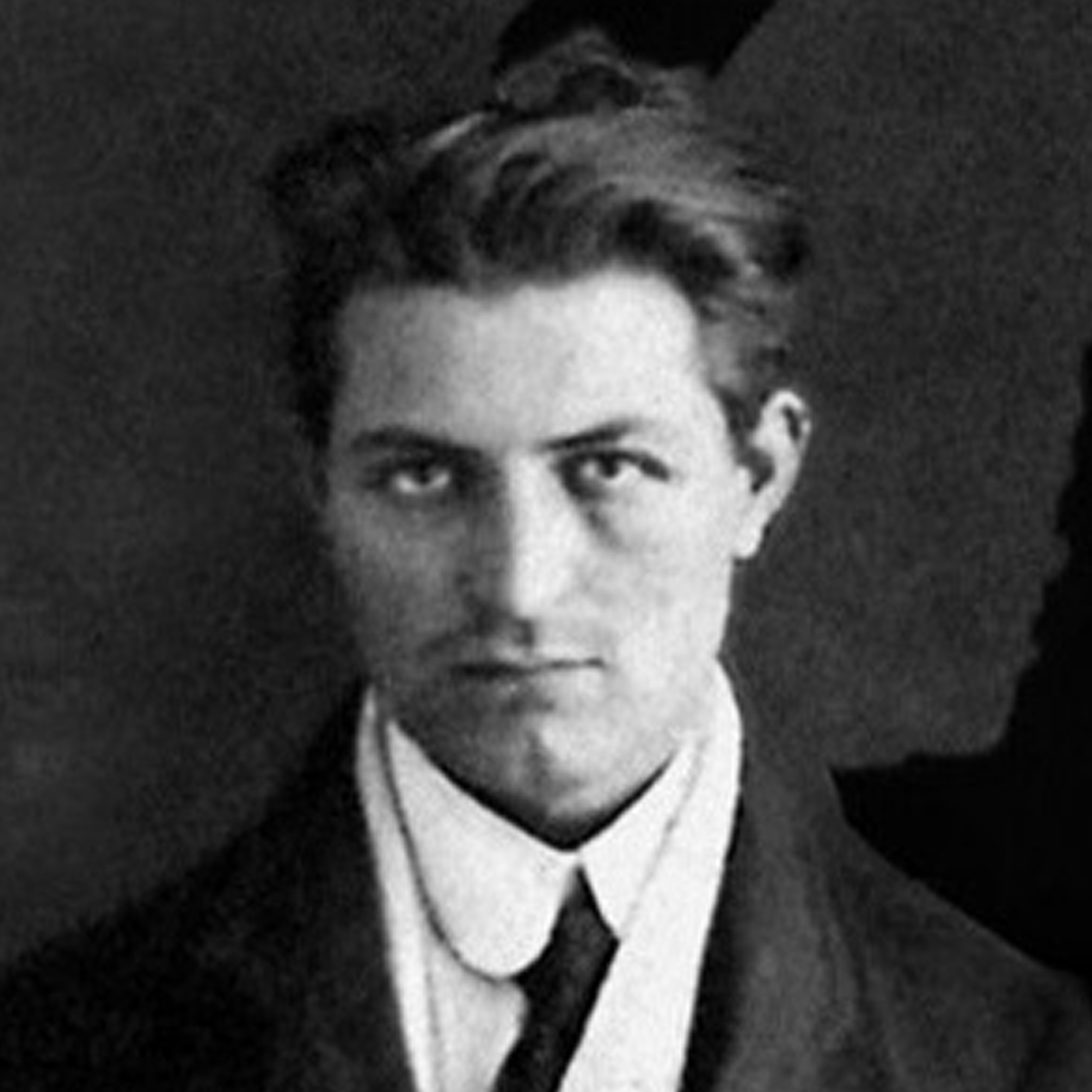
Severino Di Giovanni
- AKA
- (pseudonyms.: Nivangino Donisevere; Essedi; Mario Dionisi; Mario Vando, Folgorite, Bruno Miserafi, Pietro Esteve, Carlo Malato, Luigi Gallean and Nido Marrucino)
- Known for
- Miilitant
- Born
- Died
Biography
Born in Villamagna, Province of Chieti, in the Abruzzo region, to Carmelo Di Giovanni, a printer by trade, and María Rosa Durante.
His parents sent him to a school in Ancona. He studied to become a teacher but never completed his degree, although he would later teach in a village in Abruzzo. He learned the printing trade while reading the classics of anarchism. Around this time, his parents died, and around 1921, at the age of 20, he embraced anarchism.
With the rise of fascism in 1922, he decided to emigrate, by then already married to his cousin María Teresa Masciulli (known as “Teresina”). His brother Alessandro went into exile in France, while a third brother, Giuseppe, remained in Italy. Di Giovanni and his wife initially traveled to Brazil, settling in Santa Ana, a town near São Paulo. He worked at various jobs, including harvesting corn. Their first daughter, Laura, was born there. The couple returned to Italy with their young daughter, but the continuing rise of fascism again drove them to the Americas. This time they arrived in Buenos Aires aboard the steamship Sofía in May 1923. Teresina had crossed the Atlantic pregnant with their second daughter, Aurora (later, Ilvo and Erina would also be born in Argentina).
They settled in Ituzaingó, where Severino initially cultivated flowers, which he sold himself at the Abasto Market in Buenos Aires. Eventually, however, he found work in the trade he had learned in Italy. Like other politically active printing workers of the period, while working in printing shops as a typographer or linotype operator, he attended anarchist or antifascist meetings at night, almost always among Italians.
In the same year as his arrival, he founded the “Renzo Renovatore” group with five other Italian anarchists. On July 1, 1924, from the pages of L’Avvenire in Buenos Aires, he called for the destruction of prisons, courts, churches, and other “cardboard idols.” On October 20, he paid tribute in the same newspaper to Giacomo Matteotti, the Italian deputy murdered by the fascists, and five days later he was arrested by the Buenos Aires Provincial Police for taking part in a disturbance during a workers’ assembly.
On November 5, 1924, he described Anatole France as a “champion of freedom,” and a month later he praised the figure of Renzo Renovatore on the second anniversary of his death. On April 25, 1925, he devoted an article to Proudhon, Mazzini, Bakunin, and Marx. He was arrested again, along with nine other antifascists, on June 6, 1925, when, during an evening event at the Teatro Colón attended by President Marcelo T. de Alvear and the Italian ambassador, he interrupted the Italian royal anthem by throwing leaflets from the theater’s upper gallery, shouting slogans against the monarchy and Mussolini, and cheering for Matteotti. After a pitched battle, Di Giovanni was arrested. During police questioning, he spoke good Spanish, said he was a nonviolent anarchist, and stated that he worked at the Polli printing house in Morón, Buenos Aires Province.
He first contributed to L’Avvenire and then, in 1925, began publishing the newspaper Culmine. Pubblicazione anarchica, which he wrote and printed himself. Through it, the more radical wing of Argentine anarchism regrouped. He advocated an anti-Bolshevik anarchism and an exclusively anarchist form of antifascism, attacking “Garibaldism.” He also organized a circulating library based in his room in Morón, as well as a library of inexpensive pamphlets for Italian-speaking anarchists.
During the agitation surrounding the Sacco and Vanzetti case (1926–1927), Di Giovanni conducted an active campaign through the pages of Culmine, while also sending reports from Buenos Aires as a correspondent to L’Adunata dei Refrattari, the newspaper of Italian anarchists in New York. During a protest conference organized by La Antorcha at the Teatro Boedo on May 16, 1926, Di Giovanni’s voice, demanding “more violence” and “individual actions,” unexpectedly joined the list of speakers, winning sympathy among younger attendees. That same night, a bomb exploded at the entrance to the United States Embassy. The police raided the headquarters of the Sacco and Vanzetti Committee, confiscated the print run of La Antorcha, and arrested several prominent anarchists, placing Di Giovanni under the scrutiny of the head of the Investigations Department. On May 21, 1926, his home was raided, and a large amount of propaganda material was confiscated. He was held for a week at the Central Police Department before being released for lack of evidence. Di Giovanni denied being responsible for the embassy bombing.
He moved with his wife and three children into a house rented from the Scarfó family. Two of their sons, the young Alejandro and Paulino Scarfó, he had met at the headquarters of La Antorcha. There he met another sibling, Josefina América Scarfó, with whom he began a passionate affair. He took part in the campaign to aid the Italian anarchist Gino Lucetti and his family after Lucetti attempted to assassinate Mussolini. His former home in Morón, as well as the Scarfó house, were raided on the night of July 22, 1927, following the explosion of two bombs: one targeting an agency representing the Ford automobile company in the city center, and another placed near the Washington Monument in the Palermo neighborhood, as part of the campaign surrounding Sacco and Vanzetti. Culmine, in which Paulino Scarfó was already actively involved, published an account of how the bombs had been detonated. Di Giovanni went into hiding and constantly changed residences. He had become isolated with his small group—the Scarfó brothers, the Spaniard Gómez Oliver, Emilio Uriondo, and the Italians José Romano, Agostino Cremonesi, and Julio Montagna—having broken with his mentor Aldo Aguzzi and facing harsh attacks from the men behind the newspaper La Protesta.
On November 26, 1927, he returned to action. To avenge the deaths of Sacco and Vanzetti, he chose as his target the “Combinados” cigarette factory, which had just launched a cheap line for workers bearing the names of the libertarian martyrs. On December 24 of the same year, he detonated two powerful bombs at Citibank and the Bank of Boston in downtown Buenos Aires. La Protesta condemned the attacks, while Alberto S. Bianchi and Rodolfo González Pacheco defended them in La Antorcha. At the beginning of 1928, as part of the campaign for the freedom of Simón Radowitzky, he and Paulino Scarfó prepared an attack against Juan José Piccini, director of the Ushuaia prison, but it failed: the explosive package was easily detected.
On May 23, 1928, with José Romano assisting him, he carried out an attack against the Italian Consulate as the ambassador of Fascist Italy, former squadrist Italo Capanni, was arriving. The attack killed nine people and wounded 34. In addition to causing widespread shock throughout the country, it led to the imprisonment of 400 anarchists. That same day, Di Giovanni and Ramé unsuccessfully attempted to blow up a pharmacy in La Boca owned by Benjamín Mastronardi, the leader of a local Fascist subcommittee. Di Giovanni’s home was raided by police, who seized 5,000 anarchist and antifascist books.
On May 26, another explosion targeted the Italian military officer César Afeltra at his home in Almagro. Afeltra had been accused of torturing workers in Italy. Several members of the Cúlmine group in Berisso were arrested and interrogated. The explosives depot in Lomas del Mirador was discovered, while it was also established that Paulino Scarfó had sent the package intended for the director of the Ushuaia prison. Di Giovanni was assisted by two bakery workers from Morón, José Apugliesi and Pedro Aguirre, who sheltered him for a time while learning how to prepare explosives.
On October 14, 1928, following a maritime workers’ strike against the ships of Nicolás Mihanovich, Di Giovanni—in cooperation with groups of strikers—managed to place a bomb aboard a ship that was about to depart, although it failed to explode.
At the end of 1928, he traveled to Montevideo, where he contacted the group of “expropriator anarchists” led by Miguel Arcángel Roscigno and brothers Vicente Salvador Moretti and Antonio Salvador Moretti. Di Giovanni brought counterfeit currency produced in Montevideo by the Moretti brothers into Argentina, with the aim of obtaining funds for the campaign to free Simón Radowitzky. On November 10, 1928, a failed attack took place against the Metropolitan Cathedral, in which a young man was killed. Alejandro Scarfó was sentenced to life imprisonment in Ushuaia prison. On February 5, 1929, an armed robbery of Kloeckner company paymasters led to a shootout and a major manhunt; Bayer attributed the crime to Di Giovanni.
On April 25, 1929, Julio/Giuglio Montagna, who had been an administrator of Culmine, was shot dead four times after being accused of informing the police. Di Giovanni never denied the accusation that he was responsible for the killing. He continued to face the harshest criticism from La Protesta, which eventually described him as a “Fascist agent or police instrument.” Although Luigi Fabbri and the anarchists in New York rejected these accusations, Di Giovanni threatened the editors of the anarchist newspaper. Amid these mutual accusations, on October 25, 1929, the director of La Protesta, Emilio López Arango, was killed by three gunshots outside his home in Remedios de Escalada while caring for his sick wife and their three children. Di Giovanni demanded the establishment of an international tribunal to investigate the accusations of murder made by La Protesta.
He is also said to have planned the attack against Juan Velar, head of the Social Order Division in Rosario and an officer accused of torturing anarchist workers. The attack, on October 22, 1929, was carried out by Paulino Scarfó and Miguel A. Roscigno. At the end of January 1930, Di Giovanni was accused of the murder of Agostino Cremonessi in Rosario, another administrator of Culmine.
During 1930, Di Giovanni carried out several high-profile robberies with varying results. In the first, an attempt to rob the Avellaneda Bank, he escaped but without the money. In the second, against a bus company station, he obtained several thousand pesos; however, two days later three of his companions were arrested and subsequently sentenced to three years in Ushuaia prison for aiding and abetting. On August 7, 1930, the long-prepared attempt to free Alejandro Scarfó took place while he was being transported by police van from Caseros Prison to the courts. Di Giovanni, Paulino Scarfó, Jorge Tamayo Gavilán, and Braulio Rojas took part, but the younger Scarfó was not in the vehicle at the time.
Meanwhile, an international jury requested by Di Giovanni to assess the insults directed at him by La Protesta, and formed in Montevideo by Luigi Fabbri, Ugo Treni, and Torquato Gobbi, strongly censured the publication. Nevertheless, Di Giovanni would only feel vindicated after receiving a letter from Radowitzky, recently released by Yrigoyen and having arrived in the Uruguayan capital.
After Yrigoyen fell, and ignoring the advice of his friends to go into exile in Uruguay, Di Giovanni defied General Uriburu’s dictatorship by publishing the first volume of Reclus’s works (Scritti Sociali, Buenos Aires, I Libri di Anarchia, 1930) and carrying out a robbery of the paymasters of Obras Sanitarias on October 2, 1930. He obtained a substantial sum, but lost his companion Paco González in the operation. Beginning on October 12, 1930, he lived under a false name with Josefina and Paulino Scarfó in a country house in Burzaco, Buenos Aires Province. There they set up a printing press to publish the second volume of Reclus’s works and the fortnightly newspaper Anarchia, through which Di Giovanni, under the pseudonym Mario Vando, called for action against the dictatorship.
On January 20, 1931, three bombs exploded at different locations in the capital. Severino Di Giovanni, who was being intensely sought by police, was arrested on the afternoon of January 30 while defying surveillance around Buenos Aires printing presses in order to deliver the proofs of the second volume of Reclus’s works to a printing shop. During the shootout that accompanied the pursuit through the streets and across the rooftops of downtown Buenos Aires, a young girl and a police officer were killed.
Transferred to the National Penitentiary on Las Heras Avenue, he was sentenced to death by a military tribunal under the so-called “revolutionary decree,” for armed attacks against the authorities and for the homicide of two people.
During the 24-hour period in the prison chapel before his execution, the Italian asked to see his wife and children, as well as Fina and Paulino Scarfó, who had just been arrested. He was executed at dawn on February 1, 1931, after shouting one final time: “Long live anarchy!”
Three years later, Teresina married another anarchist militant, Tomás Ponce de León, with whom she had three more children: Eros, Nélida, and Eva.
Quote
<p>"Evviva l'Anarchia!" (Long live Anarchy!)</p>