Basket Empty
Compendium
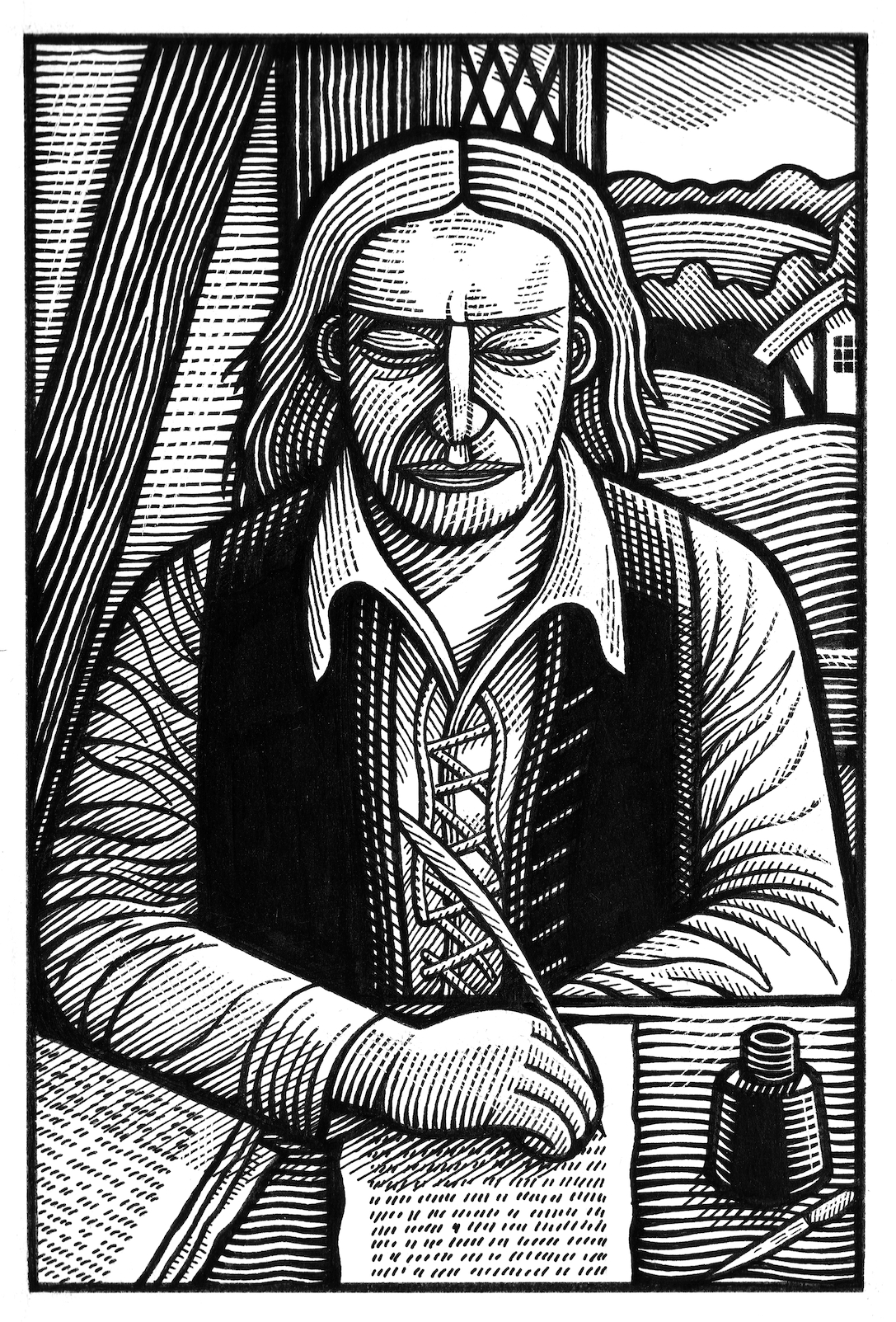
Gerrard Winstanley
- Born
- Died
Biography
English religious reformer and political thinker, a precursor of libertarian communism and Christian anarchism.
In 1648, Winstanley published a pamphlet called The New Law of Righteousness. The basis of this work came from the downtrodden state of the labouring population of England under the encroachment of private property by means of the Enclosures of common land; the remedy it espouses is the communal life, as exposed in Acts 2, verses 44 and 45: "And all that believed were together, and had all things common; And sold their possessions and goods, and parted them to all men, as every man had need." Winstanley argued that
In the beginning of Time, the great Creator Reason, made the Earth to be a Common Treasury, to preserve Beasts, Birds, Fishes, and Man, the lord that was to govern this Creation; for Man had Domination given to him, over the Beasts, Birds, and Fishes; but not one word was spoken in the beginning, That one branch of mankind should rule over another. And the Reason is this, Every single man, Male and Female, is a perfect Creature of himself; and the same Spirit that made the Globe, dwels in man to govern the Globe; so that the flesh of man being subject to Reason, his Maker, hath him to be his Teacher and Ruler within himself, therefore needs not run abroad after any Teacher and Ruler without him, for he needs not that any man should teach him, for the same Anoynting that ruled in the Son of man, teacheth him all things... And so selfish imaginations taking possession of the Five Sences, and ruling as King in the room of Reason therein, and working with Covetousnesse, did set up one man to teach and rule over another; and thereby the Spirit was killed, and man was brought into bondage, and became a greater Slave to such of his own kind, then the Beasts of the field were to him.
Winstanley took as his basic texts the Biblical sacred history, with its affirmation that all men were descended from a common stock, and with its scepticism about the rulership of kings, voiced in the Books of Samuel; and the New Testament's affirmations that God was no respecter of persons, that there were no masters or slaves under the New Covenant. From these and similar texts, he interpreted Christian teaching as calling for the abolition of property [in land] and aristocracy. For him, nature "is in effect God, and this pantheistic materialism proclaimed the equality of all people through nature as well as the usefulness of popular sciences -alchemy, astrology, herbal medicine and the magical arts."
Winstanley wrote: "Seeing the common people of England by joynt consent of person and purse have caste out Charles our Norman oppressour, wee have by this victory recovered ourselves from under his Norman yoake."
His theme was rooted in ancient English radical thought. It went back at least to the days of the Peasants' Revolt (1381) led by Wat Tyler.
On 1 April 1649, Winstanley and his followers took over vacant or common lands on St George's Hill in Surrey. Other Digger colonies followed in Buckinghamshire, Kent, and Northamptonshire. Their action was to cultivate the land and distribute food without charge to any who would join them in the work. Local landowners took fright from the Diggers' activities and in 1650 sent hired armed men to beat the Diggers and destroy their colony. Winstanley protested to the government, but to no avail, and eventually the colony was abandoned.
After the failure of the Digger experiment in Surrey in 1650, Winstanley temporarily fled to Pirton, Hertfordshire, where he took up employment as an estate steward for the aristocratic mystic Lady Eleanor Davies. This employment lasted less than a year. It ended when Davies accused Winstanley of mismanaging her property, and he then returned to Cobham.
Winstanley continued to advocate the redistribution of land. In 1652, he published another pamphlet called The Law of Freedom in a Platform, in which he argued that the Christian basis for society is where property and wages are abolished. In keeping with Winstanley's adherence to biblical models, the tract envisages a communistic society structured on non-hierarchical lines, though one likely to have voluntary patriarchs.
Quote
Was the earth made for to preserve a few covetous, proud men to live at ease, and for them to bag and barn up the treasures of the earth from others, that they might beg or starve in a fruitful land, or was it made to preserve all her children?
Archive
Gallery