Basket Empty
Compendium
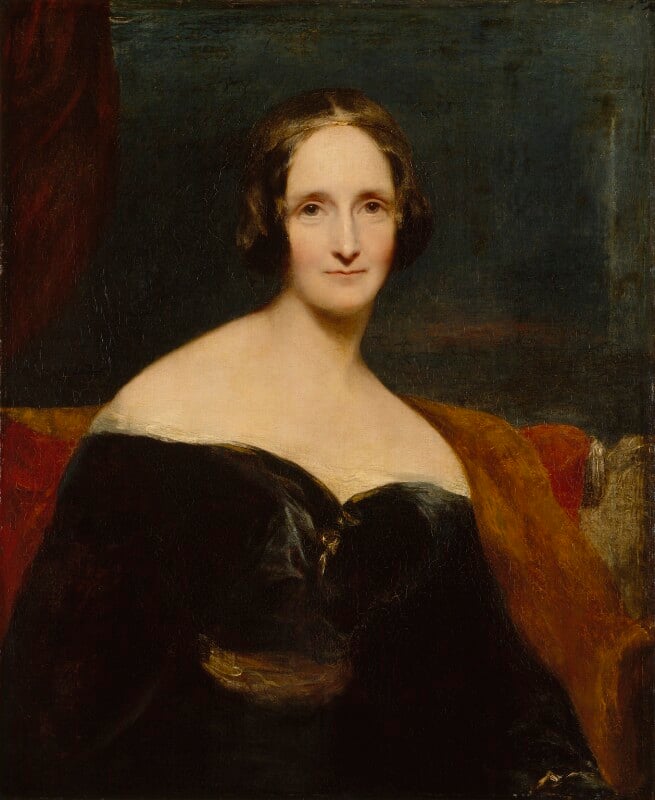
Mary Shelley
- AKA
- Mary Wollstonecraft Godwin
- Known for
- Writer
- Born
- Died
Biography
The daughter of anarchist philosopher William Godwin and feminist Mary Wollstonecraft, and author of Frankenstein.
Shelley did not identify as an anarchist in the modern political sense, but her writing contains several ideas that overlap strongly with anarchist thought, particularly opposition to coercive authority, inherited hierarchy, and systems that subordinate individual freedom. Most clearly, these sentiments appear in her novels and essays:
- Criticism of political authority and hierarchy. In The Last Man (1826), Shelley imagines the collapse of political and social institutions. Her treatment of governments is often skeptical: political leaders are portrayed as limited, self-interested, or incapable of preventing catastrophe. The novel questions whether established political structures actually protect humanity.
- Resistance to arbitrary power. In Frankenstein (1818), Victor Frankenstein's attempt to exercise absolute control over nature and over the life he creates can be read politically as well as scientifically. The Creature's subsequent rebellion against Victor reflects a recurring Shelleyan concern: when one individual assumes the right to dominate another, resistance becomes understandable, even if it becomes destructive.
- Criticism of social inequality. Shelley was deeply influenced by her parents, William Godwin and Mary Wollstonecraft. Godwin's Enquiry Concerning Political Justice argued that government and coercive institutions tend to perpetuate inequality and corrupt human relationships. Those ideas formed part of the intellectual environment in which Shelley wrote.
- Suspicion of institutions that constrain women. Shelley's feminism also intersects with anarchist ideas. Her works repeatedly depict women whose lives are constrained by marriage, patriarchy, economic dependence, and male authority. In Mathilda and The Last Man, for example, intimate relationships become sites where power and domination are exposed.
- The possibility of alternative social arrangements. The Last Man is particularly interesting because its post-apocalyptic setting strips away many conventional institutions. Shelley explores what remains when political, economic, and social structures disintegrate. The result isn't a straightforward utopian anarchist society—she is much more pessimistic than that—but she repeatedly asks whether human beings can organise themselves without relying on established hierarchies.
Archive
Gallery